
What separates PAL from NTSC in field frequency and frame rate, general mains habits by region, and the naming, pixel counts and bandwidth conversions of 720P, 960H, 1080P and higher bands.
The Difference Comes from Field Frequency and Frame Rate
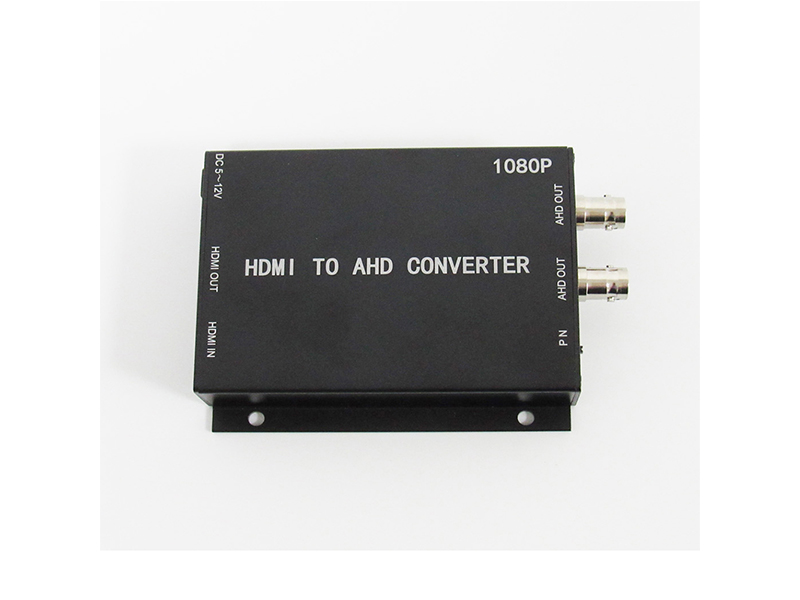
PAL and NTSC differ on two counts: pictures per second and scanning field frequency. In 50Hz mains regions a PAL picture runs at 25fps, and in 60Hz regions NTSC runs at 30fps; the camera shutter range must also cover the matching field period to avoid rolling and banding. Product labels state this directly. On the 1080P HDMI-to-AHD video converter the band switch reads P for PAL 1080P@25 and N for NTSC 1080P@30. The H.265 encoder frame-rate row reads 1 to 25fps in a 50Hz environment and 1 to 30fps in 60Hz. Network and micro cameras label the electronic shutter from 1/50 to 1/60s up to 1/10000s, covering both field frequencies.
Micro coaxial cameras switch the TV system on site from the menu: the 2MP starlight pinhole AHD micro camera VDC-MC01F20NS and the other quad-format models label TV System as PAL/NTSC (OSD switch), with menu languages in English, Simplified Chinese, Traditional Chinese and French. The 1080P Sony low-illumination 4-in-1 micro camera VDC-MC08SL lists 1920×1080@25fps and 1920×1080@30fps, matching PAL and NTSC one to one.
General Mains and TV-System Habits by Region
For export and off-site projects, inferring the TV system from mains frequency is the quickest judgement: Mainland China, Europe, most of Australia and Africa and part of the Middle East run 50Hz and habitually use PAL, while North America, Japan, South Korea and some South American countries run 60Hz and habitually use NTSC. Mains frequency and TV system are not a mandatory pairing, and in practice the bands supported by the target market's recorder decide the choice. Batches shipped from this project to Europe, the Americas, the Middle East, South-East Asia, Australia and Africa have their bands confirmed against the order before shipment.
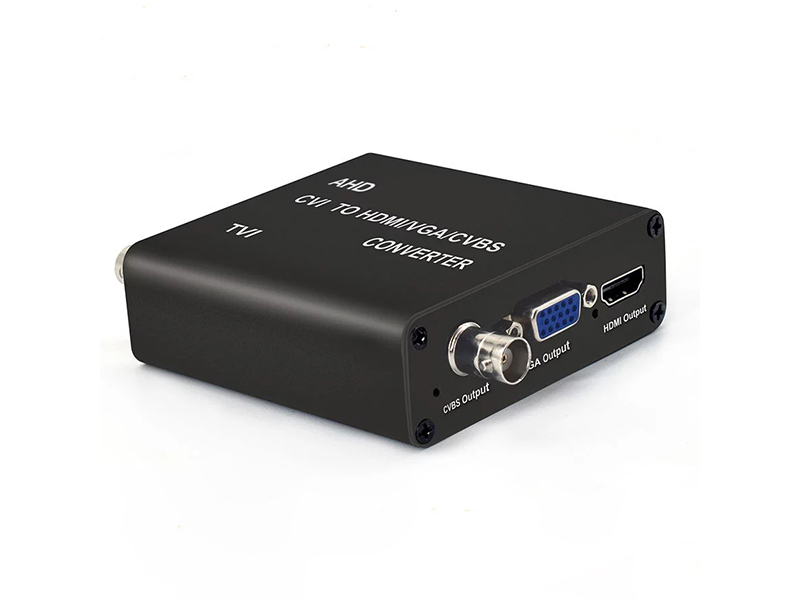
Write the judgement as three steps. First, confirm the site mains frequency. Second, confirm which band the existing recorder supports, since a band the host does not support shows no picture even when the front end switches correctly. Third, confirm the output bands of the converter and encoder: the converter's HDMI side recognises 480i60, 576i50, 720P60, 1280×1024, 1024×768, 1366×768, 1080i50, 1080i60 and 1080P25/30/50/60, covering both field-frequency environments.
Resolution Band Names and Pixels
Coaxial and network naming read alike and are easy to misread. The table sets the notations found in product parameters here against their actual pixel counts. Pixels are as labelled, and the same band can differ slightly across sensors.
| Band notation | Pixel count | Where the product labels it | Frame rate and field frequency |
|---|---|---|---|
| 720P | 1280×720 | Converter input supports 720P at 25/30/50/60Hz, digital output 720P@60Hz | Common at 60Hz |
| 960H | Enhanced standard definition, labelled CVBS/960H | The band of micro coaxial cameras in CVBS mode | PAL 25 or NTSC 30 |
| 1080P or 2MP | 1920×1080 | AHD/TVI/CVI 2MP; coaxial-to-IP encoder up to 2MP | 25fps or 30fps |
| 3MP | 2304×1296, 2048×1536 | Converter input supports 3MP; explosion-proof model 2304×1296@25fps | 25fps |
| 4MP | 2560×1440 | Selectable main-stream band on network cameras | 1 to 30fps |
| 5MP | 2560×1920, 2592×1944, 2560×1944 | Micro network camera 2560×1920@20fps; starlight 4-in-1 micro camera 2560×1944 | 20 to 30fps |
| 8MP or 4K | 3840×2160, 3072×2048 | 8MP converter input supports 8MP; 8MP bullet 3840×2160@20fps; tester main stream displays 4K | 20 to 30fps |
| 12MP | 4000×3000 | AI vandal-proof dome 4000×3000@25fps, also 4K@30fps and 2K@60fps | 25 to 30fps |
Bandwidth and Storage Conversions
The coaxial side carries baseband and takes no network bandwidth; the band only decides whether the converter and host recognise it. Bandwidth is only calculated after conversion to IP. The bitrate rows give adjustable ranges rather than fixed values: H.265 64K to 2048Kbps, H.264 64K to 4096Kbps, 8MP models 32Kbps to 16Mbps, and 12MP models 0.1Mbps to 12Mbps. Plan access bandwidth and storage against the upper limits, not the averages.
The conversion is per-channel daily capacity equal to bitrate times 86400 seconds divided by 8. That gives about 21.6GB per day at 2Mbps, 43.2GB at 4Mbps, 64.8GB at 6Mbps, 86.4GB at 8Mbps, 129.6GB at 12Mbps and 172.8GB at 16Mbps. Keeping 8 channels at 4Mbps for 30 days needs about 10.4TB, and 16 channels on the same setting about 20.7TB. Budget the network uplink at gigabit: 16 channels at 4Mbps total 64Mbps, which leaves ample margin on a gigabit link but already uses close to half of a 100 Mbps link.
Symptoms and Judgement of a TV System Mismatch
A TV system that does not match the host behaves in fixed ways: no picture after switching, picture rolling top to bottom, border jitter, or a forced drop in frame rate. Judge by checking the front-end menu's TV System first, then the recorder's input TV-system setting, and finally adapting with the converter or encoder P/N positions. During testing a CCTV tester reads the band directly: the 7-inch IPS touchscreen 5-in-1 4K CCTV tester supports 8MP TVI and 8MP AHD tests, records and plays back at the 3840×2160P@15fps band, and can open the camera OSD menu to change the TV system.
TV system and frame rate are preset items on batch orders. Shenzhen VIDCOM Technology Co., Ltd. supports firmware parameter presets, so write the target market, mains frequency and recorder model into the requirement sheet and you avoid switching units one by one through the menu on site.
Confirmation and Contact
Send the destination country, the site mains frequency, the existing recorder model and the resolution band you need to info@vctcctv.com, or call +86-755-28146081, and we name the models that connect directly on that band plus the matching converter. The works are at 4F, Building 2, Zhongtai Industrial Park, Donghuan 1st Road, Longhua District, Shenzhen, and WhatsApp at +86-15989322654 handles communication for overseas customers.