
Starting from the detector specification and stated measurement accuracy of dual-spectrum thermal cameras: where thermal and visible channels apply, plus mounting, passage distance and interlocks.
What Each of the Two Channels Carries
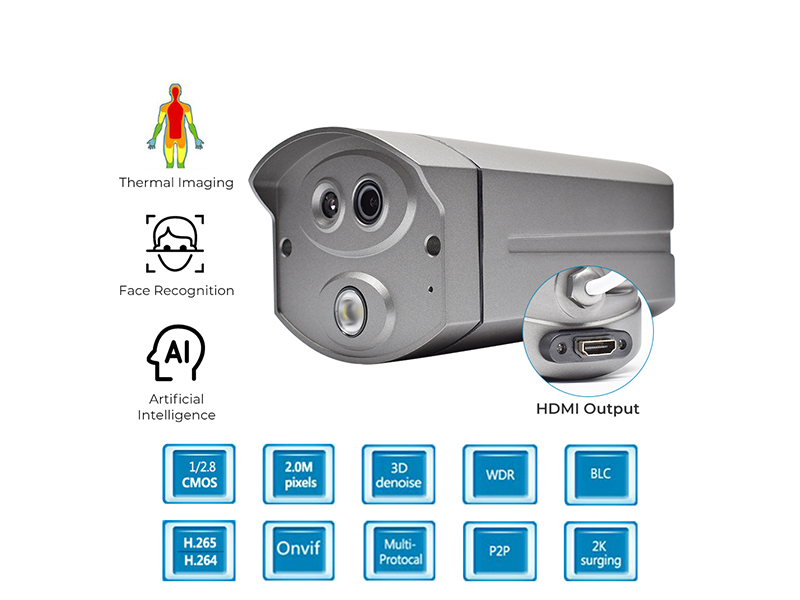
A dual-spectrum build places a thermal imaging module beside a visible-light module. The thermal side uses an uncooled vanadium-oxide detector at 256×192 resolution with 12 µm pixels, and can output palettes such as white hot, black hot, fusion, rainbow, iron red and amber. The visible side is a 1/2.8-inch 2MP CMOS with colour sensitivity of 0.005Lux and black and white at 0.001Lux, wide dynamic range of at least 80 dB, and a 3.6 or 4 mm lens giving 84° horizontal and 45° vertical.
The division of work is clear: thermal finds temperature anomalies and human presence without light, visible carries evidence detail and face matching. At 256×192 the thermal channel resolves far below the 2MP visible sensor, so identifying facial features or reading a plate from it does not hold; when detail is required, treat the visible picture as the source. The HDMI dual-spectrum thermal imaging camera can send both channels to a local display over HDMI for one-screen viewing.
Premises Behind the Stated Accuracy
The accuracy the product states is band-specific, not one figure for the whole range. The VDC-FRT9265R-HP and the VDC-FRT9265R-HB with a built-in blackbody list a measurement range of -15 to 150 °C, accuracy of ±0.3 °C while the target temperature sits between 35 and 38 °C, and ±0.6 °C between 20 and 33 °C or 38 and 50 °C. Human screening falls in the 35 to 38 °C band, which is the range the accuracy claim covers.
Access-control units narrow the range further. The VDC-FRIP20SL-T2 measures 30 to 45 °C at ±0.3 °C, responds in under 300 ms, works at an effective distance of 0.3 to 0.8 m for heights of 1.2 to 2.2 m, adjusts its vertical angle by ±30°, recognises in under 500 ms, and detects 20 to 30 faces at once. The table pairs these specifications with the site conditions they assume.
| Parameter | Product label | Condition for it to hold |
|---|---|---|
| Measurement range | -15°C to 150°C (HP, HB) | A model covering 30°C to 45°C fits human screening better |
| Measurement accuracy | ±0.3°C at a target temperature of 35°C to 38°C | Target temperature inside that band and facing the lens |
| Effective measuring distance | 0.3 to 0.8 m (T2) | Set corridor width accordingly; no reading beyond range |
| Response time | Under 300 ms | Pedestrians pass at an even pace without stopping |
| Concurrent faces | 20 to 30 faces detected at once | Keep footfall density in the passage below that |
| Face database capacity | 50000 faces (HP, HB) / 22400 faces (T2) | Plan local matching against the database capacity |
| Reference standard | HB model integrates a blackbody in the housing | Online measurement needs a stable reference source |
| Local records | HB built-in 16GB storage, up to 100000 temperature records | Measurement data is kept during network outages |
Where It Applies and Where It Does Not
Thermal measures surface temperature, and the reading is the combined effect of emissivity, wind speed, sunlight and sweat. Passage screening and temperature-anomaly alarming are the device's design uses; it cannot replace medical temperature measurement. Region temperature-difference alarms with over-temperature and low-temperature interlocks suit equipment and spatial temperature distribution, for example rack rows, electrical rooms and warehouse racking.
The applicable and non-applicable cases below are drawn from product capability, ready to use when writing a proposal.
- Applies: temperature screening and footfall temperature watch at building, factory and station entrances.
- Applies: heat-source finding and region temperature-difference alarms with no visible light, since thermal imaging does not rely on ambient illumination.
- Applies: passage control interlocked with access equipment. The T2 model provides Wiegand 26/34 input and output plus one relay alarm output, and a USB port for an ID-card reader.
- Applies: local retention during network outages. The HB model's built-in storage holds up to 100000 temperature records.
- Does not apply: measuring through ordinary glass, which is not transparent to the infrared band.
- Does not apply: as a basis for medical diagnosis, or for estimating deep body temperature.
- Does not apply: evidence work that needs facial detail, text or plate numbers; hand those to the visible channel.
Mounting Position and Interference Sources
Direct sunlight on the target, an air-conditioning outlet facing the passage, plant-room equipment or an oven in the background all pull readings away from the real band and trigger false alarms. When placing the camera, keep hot air from blowing between target and lens, avoid high-temperature backgrounds inside the same frame, and if needed restrict the region-measurement box to the walking path.
Ingress protection and working temperature decide whether outdoor mounting is possible. The VDC-FRT9265R-HP is rated IP67 and the VDC-FRT9265R-HB IP64; both work from -20 to 55 °C, at 0% to 90% humidity, on DC12V, drawing no more than 5 W. The T2 access unit works from -15 to 60 °C at up to 20 W, so it is an indoor device, with a 33 mm pole mounting hole.
Network Access and Image Upload
On protocols, both HP and HB list RTSP, RTP, TCP, UDP, UPNP, DHCP, PPPoE, ONVIF and GB28181. The network interface is one 10/100BaseT RJ45, with one alarm output and one audio input and output. Face captures pass through algorithmic detection, exposure, scoring and filtering, then upload over FTP and HTTP as face, head-and-shoulders, upper-body, full-body and original images.
To bring HDMI dual-spectrum video into an existing network system, use the H.265 1080P HDMI network encoder: one HDMI input up to 1080P@30fps, H.265 and H.264 video encoding, AAC, G.711U and G.711A audio, output over RTSP, RTMP and TS streams, bitrate adjustable from 64kbps to 12Mbps, ONVIF support, and it connects to a network video recorder.
Information to Provide for Selection
Send the corridor width, the distance pedestrians pass at, the mounting height and orientation, whether the point is outdoors, the target recorder or platform protocol, and the alarm interlock you expect to info@vctcctv.com, or call +86-755-28146081. Supply and TV-system habits differ by market and firmware parameters can be preset before shipment; the same company address info@vctcctv.com also accepts English-language enquiries and OEM requests.