
Sensor configuration, temperature range and accuracy of the dual-spectrum thermometry camera, plus the on-site calibration steps and deployment notes for the blackbody version.
Model Configuration
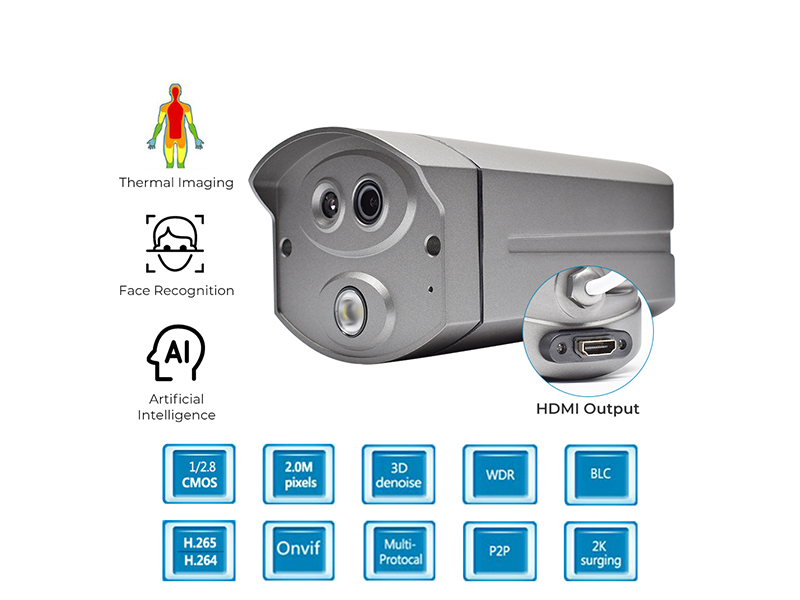
The blackbody model VDC-FRT 9265R-H B uses an uncooled vanadium oxide thermal imaging detector at 256x192 resolution with a 12 micron pixel pitch, and the thermal lens comes in 2.0mm, 3.2mm and 4.3mm options. The visible-light side is a 1/2.8 inch 2MP CMOS, with minimum illumination of 0.005Lux@F1.2 in color and 0.001Lux@F1.2 in black and white, wide dynamic range of at least 80dB and signal-to-noise ratio of at least 46dB. The two pictures output side by side inside one housing, with the visible channel used to confirm target position.
The temperature range is -15°C to 150°C, with an accuracy of ±0.3°C across the 35°C to 38°C band. The body carries 16GB of built-in storage for temperature records and snapshots, and the thermal image supports palettes such as white hot, black hot, fusion and rainbow. Interfaces include one HDMI, one RJ45 Ethernet port, one alarm output and audio input and output, with RTSP, RTP, TCP and UDP and related protocols on the network side. The unit measures 235x136x92 mm, weighs below 1.2 kg, runs on 12V DC at no more than 5 W, is rated IP64, and works from -20°C to 55°C.
What the Blackbody Version Solves
Thermometry readings drift with ambient temperature, mounting height and the emissivity of the measured target. The blackbody version mounts an area-source blackbody as a known-temperature reference target on the same bracket; while measuring through its channel, the camera treats the blackbody face as a baseline for checking reading deviation under the current environment, and the site corrects the judgment thresholds against the reference when necessary.
The same series also includes a 256x192 face-recognition temperature model rated IP67, sized 246x101x81 mm and below 1 kg; and a human-body temperature face-access model built on the HiSilicon Hi3516DV300 solution with Linux and 16G storage, a 1/2.7 inch CMOS plus a 4.5mm lens, whose dual-spectrum structure supports liveness detection. Corridor-style deployment and access-gate style deployment map to these units respectively.
On-Site Calibration Steps
Calibration follows a fixed order with each step left on the record sheet, so the reference step is never skipped straight into threshold changes. One trained operator performs the work on site while the others handle reading and recording, and the two roles cross-check once after each round. Record sheets are archived per point and serve as the starting point of the next calibration; the firmware version and the settings of the day are written on the same page.
- Power up and rest, letting the unit and bracket reach a stable state before reading
- Confirm the blackbody panel is clean and unobstructed, square to the thermal lens field of view
- Set the measured area, choosing between global thermometry and region thermometry modes
- Record the difference between the blackbody reference reading and its set value as this run's offset
- Check the high-temperature and low-temperature alarm thresholds against the offset and run the linkage test
- Save the current configuration and preset the OSD language and network parameters per order
Deployment and Follow-Up Support
When installing, prioritize the target's fill in the frame: lens focal length decides coverage width and detection distance, with 2.0mm wide but short-reaching and 4.3mm the opposite. Avoid facing glass, air-conditioning outlets and strongly reflective walls directly, as all of them bring false readings. Where records must be kept long term, wire the alarm linkage to external storage or the recording host side and treat the camera's own storage as backup. After adjustment, write the ambient temperature at the time, the lens option and the set thresholds into the record for the next recalibration.
These models support customization of structure, silkscreen, lens focal length and firmware presets, with 3 to 5 samples available for on-site evaluation. To confirm the coverage width of a given lens option, or to request the calibration record template, email info@vctcctv.com, or call +86-755-33130307 to reach the thermal imaging project team.